
Why this story matters
Many companies begin their SaaS integration journey asking the same question:
Where do we start?
That was the focus of my first article.
The second one went a step further, exposing the five most common mistakes organizations make when integrating SaaS tools — mistakes I’ve seen repeatedly over the past decades working on large-scale systems and integration projects in North America.
But theory only gets us so far.
At some point, the real question becomes:
What does success actually look like in the real world?
Not in a slide deck.
Not in a vendor demo.
But inside a large, complex organization, where people, processes, and technology must change together.
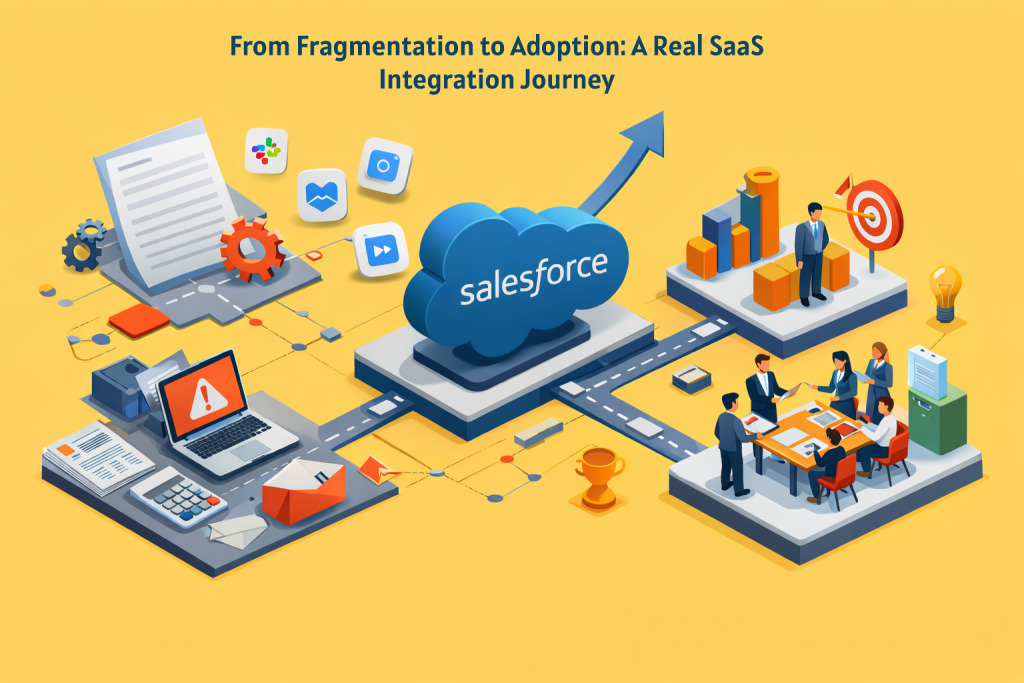
This article tells the story of how PwC Canada approached Salesforce integration — not as a software rollout, but as a business transformation. And why that decision made all the difference.
The situation before Salesforce: fragmentation disguised as productivity
Before Salesforce entered the picture, PwC Canada looked like many large organizations I’ve worked with.
Smart people.
Strong teams.
Well-established processes.
And yet, beneath the surface, there was a familiar pattern:
- Multiple CRM tools used across regions and service lines
- Different teams tracking opportunities in different ways
- Data living in silos, with limited visibility across the organization
- Manual workarounds quietly filling the gaps between systems
On paper, work was getting done.
In reality, effort was being duplicated, insights were delayed, and decision-making depended more on experience than on reliable, shared data.
This is a pattern I’ve seen many times.
It’s what happens when fragmentation slowly becomes normalized — when disconnected systems start to feel like “just the way things are.”
And this is exactly where many SaaS integration initiatives begin… already at risk.
The real problem wasn’t technology
It’s tempting to think that the solution to this kind of fragmentation is purely technical.
A new CRM.
Better integrations.
More automation.
But in PwC Canada’s case — just like in many projects I’ve been involved in — Salesforce itself was never the hard part.
The real challenge was changing how people worked day to day.
Partners, managers, and teams had built habits over years.
They had their own ways of tracking relationships, managing opportunities, and sharing information.
Introducing a new platform without addressing those behaviors would have led to a very common outcome:
A modern tool sitting on top of old habits.
This is where many integrations fail — and where one of the most common mistakes I discussed earlier shows up clearly:
Treating SaaS integration as an IT project instead of a change initiative.
PwC Canada understood that risk early.
The turning point: treating Salesforce as a business transformation
The decision to adopt Salesforce Sales Cloud was not framed as a system replacement.
It was framed as a way to create a single, shared view of clients and opportunities across the organization — and to support how teams actually worked.
That framing mattered.
Salesforce was positioned as:
- A business platform, not just a tool
- A foundation for consistency, not control
- An enabler of collaboration, not an administrative burden
Just as importantly, the initiative had visible executive sponsorship and a clear message:
This is not about forcing compliance. It’s about enabling better decisions and better outcomes.
From that point on, the focus shifted from configuration to adoption.
And that’s where this story really becomes interesting.
Integration + change management: what PwC did differently
This is the point where many SaaS integration stories start to sound the same.
APIs were configured.
Systems were connected.
Data started flowing.
And yet — months later — teams quietly drift back to spreadsheets, emails, and manual workarounds.
I’ve seen this happen more times than I can count. PwC Canada took a different path because they understood something that is often underestimated:
Integration only works when people change how they work.
The integration layer: necessary, but not sufficient
From a technical perspective, Salesforce Sales Cloud became the central system of record.
It provided a unified view of clients, opportunities, and pipeline across teams and regions.
This part is important — but it’s also the part most organizations focus on exclusively.
Connect the systems.
Sync the data.
Declare success.
In reality, that’s just the starting line.
I’ve worked on projects where integrations were technically sound, well-architected, and thoroughly tested — and still failed to deliver value because the organization assumed that usage would naturally follow.
It rarely does.
The human layer: where success was actually decided
What made PwC Canada’s approach stand out was the emphasis on how people would adopt the platform, not just how it would be deployed.
Instead of relying on generic training sessions or documentation that nobody revisits, they invested in:
- Hands-on, immersive learning, designed around real scenarios
- Training experiences that encouraged exploration and problem-solving
- Enablement tailored to different roles, not a one-size-fits-all model
- Continuous reinforcement after go-live, not just before it
This aligns closely with what I described in the previous article as one of the most critical mistakes:
Assuming that integration is “set and forget.”
In practice, adoption is a process — not an event.
Why this matters more than architecture diagrams
At this stage, the difference between success and failure had very little to do with Salesforce itself.
It had everything to do with behavior.
- Were teams entering data consistently?
- Were opportunities being updated in real time?
- Were people trusting the system enough to rely on it for decisions?
These are not technical questions.
They are change-management questions.
And this is where frameworks like ADKAR become practical rather than theoretical:
- Awareness of why the change mattered
- Desire to adopt it because it made work easier, not harder
- Knowledge of how to use it in real scenarios
- Ability to apply it consistently under pressure
- Reinforcement to prevent regression to old habits
In my experience, when any one of these elements is missing, integrations quietly lose momentum.
PwC Canada addressed all five.
The results: when integration actually sticks
The outcome of this approach was not subtle.
Publicly shared results show:
- Over 90% adoption among key users within the first week in some regions
- A 151% increase in opportunity value shortly after rollout
- 300% pipeline growth reported in U.S. operations
- More than 80% of global revenue now tracked through Salesforce
These numbers are impressive — but what’s more important is why they happened.
They weren’t driven by advanced configuration.
They weren’t driven by customization for its own sake.
They were driven by alignment between systems, processes, and people.
This is the point where SaaS integration stops being an IT initiative and becomes a business capability.
How This Case Brings the Five Integration Mistakes to Life
Looking back at the five common SaaS integration mistakes discussed earlier, this case reinforces them almost one by one:
- Integration without adoption fails
- Tools don’t change behavior — leadership does
- Metrics must measure outcomes, not just usage
- Change management is not optional
- Real success happens after go-live, not at it
PwC Canada didn’t avoid these mistakes by accident.
They avoided them by design.
Final reflection
After years of working on integration initiatives, one pattern has become clear to me:
The difference between a failed SaaS tool rollout and a successful one is rarely the platform itself.
It’s the discipline around integration, adoption, and reinforcement.
PwC Canada didn’t succeed because they chose Salesforce.
They succeeded because they treated integration as a long-term capability, not a short-term project.
Most organizations don’t fail at integration because of technology.
They fail because they underestimate what it takes to change how people actually work.
In the next article, I’ll go one level deeper and share practical signals you can use to detect early when a SaaS integration is drifting toward failure — before it becomes visible in the numbers.
(This is usually where recovery is still possible.)