
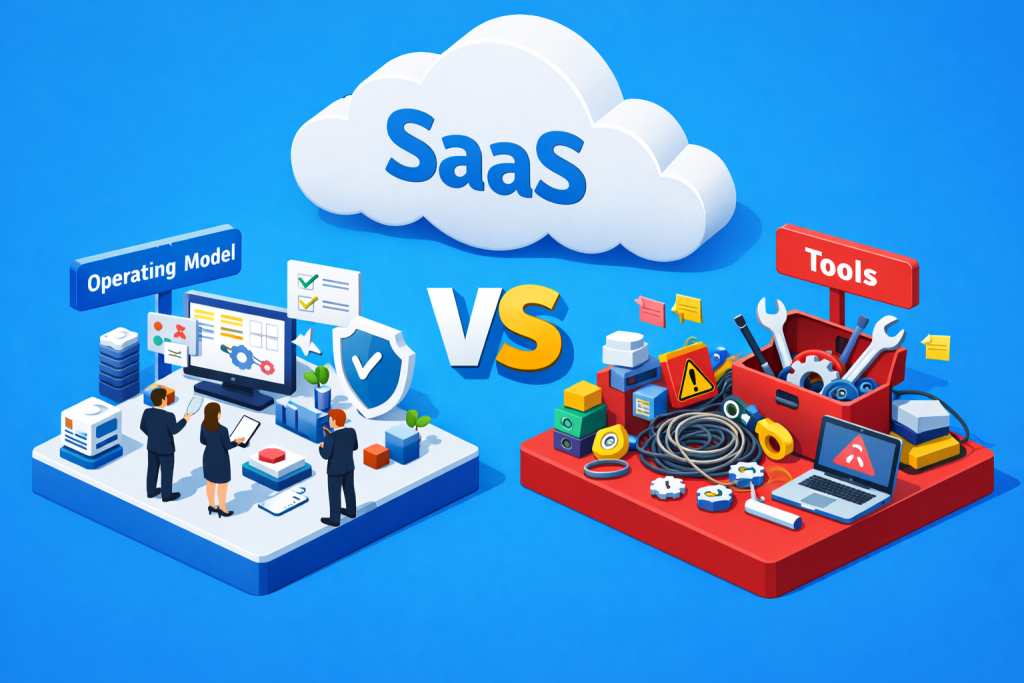
From Ad-Hoc Integrations to Operating Models: Why SaaS Needs a New Way of Thinking
The Illusion of Progress
In many organizations, SaaS integration feels like constant progress.
A new tool is deployed.
A new automation has been added.
A new script connects two systems that didn’t talk before.
From the outside, everything looks like forward motion.
But underneath that surface, something else is happening.
The integration landscape becomes increasingly fragile, harder to understand, and more dependent on individual knowledge. Changes take longer. Incidents feel harder to diagnose. Teams hesitate before touching “that integration that somehow works.”
What looks like progress is often accumulated complexity.
The problem isn’t a lack of technology.
It’s the absence of a coherent way of thinking about integrations as a system.
The Tool Trap
When integrations start to struggle, the instinctive reaction is predictable:
- Add another tool
- Adopt a new platform
- Replace one connector with another
- Introduce a new automation layer
Tools promise speed, coverage, and simplicity. And in isolation, many of them deliver exactly that.
But tools solve localized problems.
They don’t define:
- how integrations should be designed
- who owns them
- how they evolve
- how they scale with the business
As a result, organizations accumulate solutions without coherence.
More tools don’t reduce complexity.
They often redistribute it.
At some point, the challenge is no longer technical. It’s structural.
How Ad-Hoc Integrations Are Born
Most fragile integration landscapes don’t start with bad decisions.
They start with urgency.
A department needs data.
A deadline is approaching.
A workaround is required “just for now.”
Someone builds an integration to solve a specific need. It works. Everyone moves on.
Then another need appears. And another. Each one reasonable. Each one isolated.
Over time, these integrations form a web that no one intentionally designed.
Common warning signs begin to appear:
- “Only one person really understands this flow.”
- “Don’t touch it — it might break.”
- “We’ll clean it up later.”
Later rarely comes.
Ad-hoc integrations are not the result of incompetence.
They are the result of operating without a shared integration model.
Why Integrations Break at Scale
What works at small scale rarely survives growth unchanged.
As organizations grow, integrations face pressures they were never designed to handle:
- increased transaction volumes
- stricter performance expectations
- more users triggering concurrent processes
- more systems depending on the same data
Without clear design principles, integrations begin to fail in subtle ways:
- timeouts appear sporadically
- quotas are exceeded unexpectedly
- failures cascade across systems
- recovery becomes manual and stressful
Most integrations are built to work, not to last.
And longevity requires intention.
The Hidden Cost of Improvisation
The real cost of ad-hoc integrations is rarely visible on a balance sheet.
It shows up as:
- recurring firefighting
- delayed initiatives
- risk-averse teams are afraid to change anything
- reliance on tribal knowledge
- stress concentrated around a few key individuals
Organizations don’t fail because integrations break.
They fail because they cannot change safely anymore.
Without a guiding structure, every modification feels dangerous.
What Mature Organizations Do Differently
Organizations that scale successfully treat integrations differently.
Not because they have better tools — but because they have clearer principles.
They don’t design integrations as isolated projects.
They design them as part of an operating model.
That model defines:
- how integrations are conceived
- how responsibilities are assigned
- how consistency is maintained
- how changes are absorbed without disruption
This mindset reduces dependency on individuals and increases organizational resilience.
It’s not about control.
It’s about clarity.
What Is an Integration Operating Model?
An integration operating model is not a product.
It is not an architecture diagram.
It is not a single tool or platform.
It is a shared way of thinking that answers fundamental questions:
- Who owns integrations, beyond initial delivery?
- How are design decisions made and documented?
- What principles guide integration patterns?
- How do integrations evolve as the business changes?
An operating model creates alignment.
It allows multiple teams to work independently while remaining coherent.
Projects vs Operating Models
Projects have a beginning and an end.
They deliver something. Then responsibility fades.
Operating models persist.
They guide decisions long after initial implementation.
They adapt as systems, teams, and priorities evolve.
This distinction matters.
Integrations treated as projects accumulate technical debt.
Integrations guided by an operating model accumulate organizational learning.
One decays over time.
The other strengthens.
Why Mid-Size Organizations Feel the Pain First
Mid-size organizations often sit in the most uncomfortable position.
They are:
- too large to rely on informal coordination
- too small to absorb repeated integration failures
- highly dependent on SaaS for core operations
Their integration challenges are rarely dramatic — but they are constant.
Without a model, every new SaaS adoption adds friction.
With a model, each addition strengthens the system.
The Real Problem Isn’t Technical
Most integration failures are framed as technical issues:
- APIs
- limits
- performance
- connectivity
In reality, these are symptoms.
The underlying problem is a lack of structure.
SaaS integrations don’t fail because tools are inadequate.
They fail because there is no operating model holding them together.
A Necessary Shift in Thinking
The future of SaaS integration is not about more tools.
It is about better thinking.
Organizations that succeed will be those that move from improvisation to intention — from ad-hoc connections to structured operating models.
In upcoming articles, I’ll explore what such an operating model looks like in practice, and how organizations can adopt it incrementally without disruption.
Because integrations that stick are not built by accident.
They are designed to last.