
Beyond tools and projects — building integrations that last
From Concept to Discipline
In the previous article, I argued that SaaS integrations don’t fail because organizations lack tools. They fail because they lack an operating model.
But that raises a more important question:
If tools are not the answer, what actually makes an integration operating model effective?
An operating model is not a diagram.
It is not a governance checklist.
It is not a technology stack.
It is a disciplined way of making integration decisions — consistently, intentionally, and sustainably.
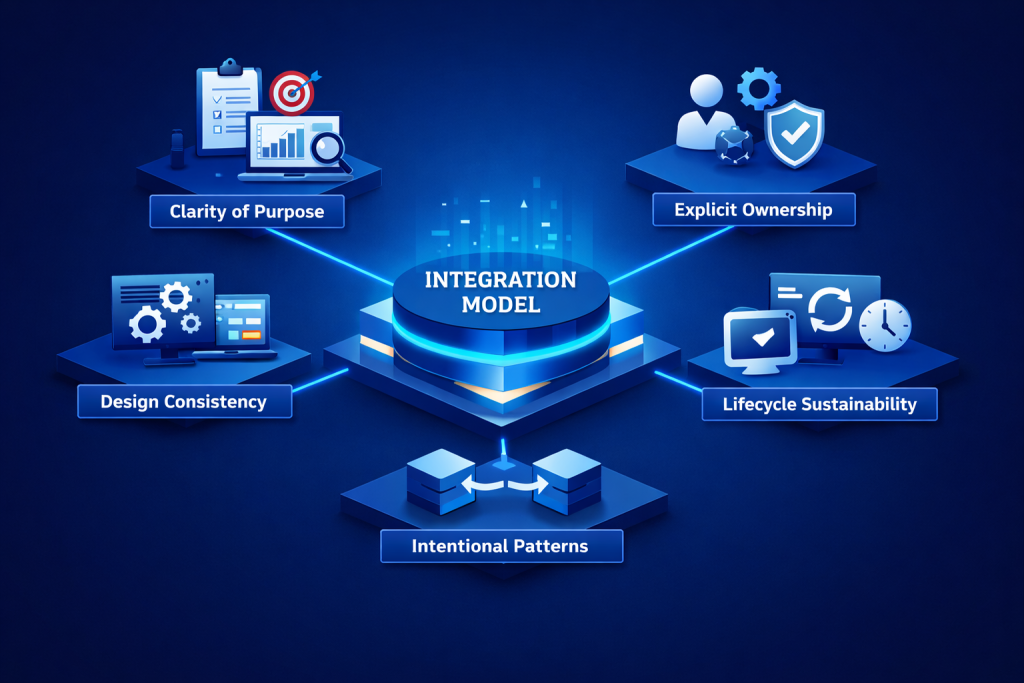
Over time, I’ve observed that successful SaaS integration environments tend to share five core principles. When these principles are present, integrations scale with the business. When they are absent, complexity accumulates quietly until fragility becomes inevitable.
Let’s examine them.
Principle 1: Clarity of Integration Purpose
Every integration should exist for a clearly defined reason.
Yet in many organizations, integrations are built reactively:
- A department needs data.
- A workflow requires automation.
- A short-term inefficiency must be resolved.
Months later, few can clearly articulate why the integration exists or whether it still delivers value.
Clarity requires that every integration:
- Supports a defined business objective.
- Has measurable outcomes.
- Can be justified strategically.
If you cannot clearly explain why an integration exists, it should be questioned.
Without clarity, integration landscapes grow reactively.
With clarity, they grow intentionally.
Principle 2: Explicit Ownership
One of the most common weaknesses in SaaS environments is ambiguous ownership.
Integrations are delivered during projects.
Once the project ends, responsibility becomes diffuse.
Over time:
- Monitoring becomes inconsistent.
- Performance issues linger.
- Changes feel risky because accountability is unclear.
Effective operating models define ownership at two levels:
Technical ownership — accountability for performance, stability, and monitoring.
Functional ownership — accountability for business alignment and evolution.
Ownership is not about control.
It is about long-term accountability.
Integrations without ownership eventually become liabilities.
Principle 3: Design Consistency
As SaaS portfolios expand, integration patterns multiply.
Without shared design principles:
- Naming conventions vary.
- Error handling differs.
- Logging and monitoring lack uniformity.
- Architectural decisions remain undocumented.
This inconsistency increases cognitive load and operational risk.
Design consistency does not mean rigidity.
It means predictability.
When integrations follow shared design principles:
- Onboarding becomes faster.
- Troubleshooting becomes simpler.
- Scaling becomes more manageable.
Consistency reduces fragility more effectively than adding complexity ever can.
Principle 4: Intentional Integration Patterns
Many integration failures are not caused by poor APIs. They are caused by accidental architecture.
Point-to-point connections, tightly coupled synchronous workflows, and convenience-based integrations may function initially — but they rarely scale gracefully.
An effective operating model defines:
- When synchronous communication is appropriate.
- When asynchronous patterns reduce risk.
- How data ownership boundaries are respected.
- How cascading dependencies are prevented.
Integration patterns must be intentional, not accidental.
Architecture does not simply emerge from tools.
It must be designed deliberately.
When patterns are chosen intentionally, scaling becomes sustainable rather than reactive.
Principle 5: Lifecycle Sustainability
Integrations are not static assets. They evolve as the business evolves.
New SaaS applications are introduced.
Existing tools change their APIs.
Processes are redesigned.
Without lifecycle discipline, integrations degrade over time.
Sustainability requires:
- Monitoring and observability.
- Living documentation.
- Periodic review and refactoring.
- Clear retirement strategies.
An integration that cannot evolve safely will eventually break.
Operating models recognize that integration is not a one-time activity. It is an ongoing discipline.
Why These Principles Must Work Together
Each of these principles is valuable on its own.
But their true power emerges when they function as a coherent system.
Clarity without ownership creates vision without accountability.
Ownership without design consistency creates disciplined chaos.
Design consistency without lifecycle thinking creates well-structured fragility.
An effective SaaS integration operating model connects these principles into a unified structure — one that guides decisions consistently across projects, teams, and time.
Over the years, I began organizing these principles into a more structured and repeatable way of thinking — a practical framework that helps organizations move from ad-hoc integration toward disciplined integration environments.
In the next article, I will explore how these principles can be connected into a cohesive framework for building a sustainable SaaS integration operating model.
Because sustainable SaaS integration is not achieved by adding more tools.
It is achieved by applying structure with discipline.