
Connecting integration principles into a disciplined and scalable model
The Missing Link Between Principles and Execution
In the previous article, I explored the five core principles that define an effective SaaS integration operating model.
Clarity. Ownership. Design consistency. Integration patterns. Lifecycle sustainability.
Individually, these principles are not controversial. Most organizations would agree with them. Many already recognize their importance.
Yet despite that awareness, integration environments often remain fragile, inconsistent, and difficult to scale.
Why?
Because principles alone are not enough.
Principles guide thinking.
Structure enables execution.
Why Principles Alone Are Not Enough
One of the most common misconceptions in SaaS integration is that understanding best practices is sufficient to achieve stability.
It isn’t.
Organizations frequently operate with a set of implicit principles:
- Teams understand the importance of ownership.
- Architects advocate for consistent design.
- Engineers recognize the need for better patterns.
But without structure, these principles are applied unevenly.
Different teams interpret them differently.
Decisions are made in isolation.
Trade-offs are handled inconsistently.
Over time, this leads to fragmentation — even when everyone is aligned in intent.
Without structure, even the right principles produce inconsistent outcomes.
From Principles to Structure
If principles are the foundation, structure is what turns them into a working system.
A SaaS integration operating model requires more than guidance.
It requires a way to apply that guidance consistently across:
- projects
- teams
- and time
This means connecting principles into a logical, repeatable flow.
Not a rigid sequence, but a coherent structure that ensures key decisions are never left to chance.
What organizations need is not more guidance.
They need a structured way to apply it.
A Structured Framework for Integration Discipline
Over time, working across different SaaS integration environments, I began to notice recurring patterns.
The same issues appeared repeatedly:
- integrations built without a clear purpose
- ownership that faded after delivery
- inconsistent design decisions
- accidental architectural dependencies
- integrations that degraded over time
At the same time, successful environments shared something in common:
a disciplined way of connecting these concerns.
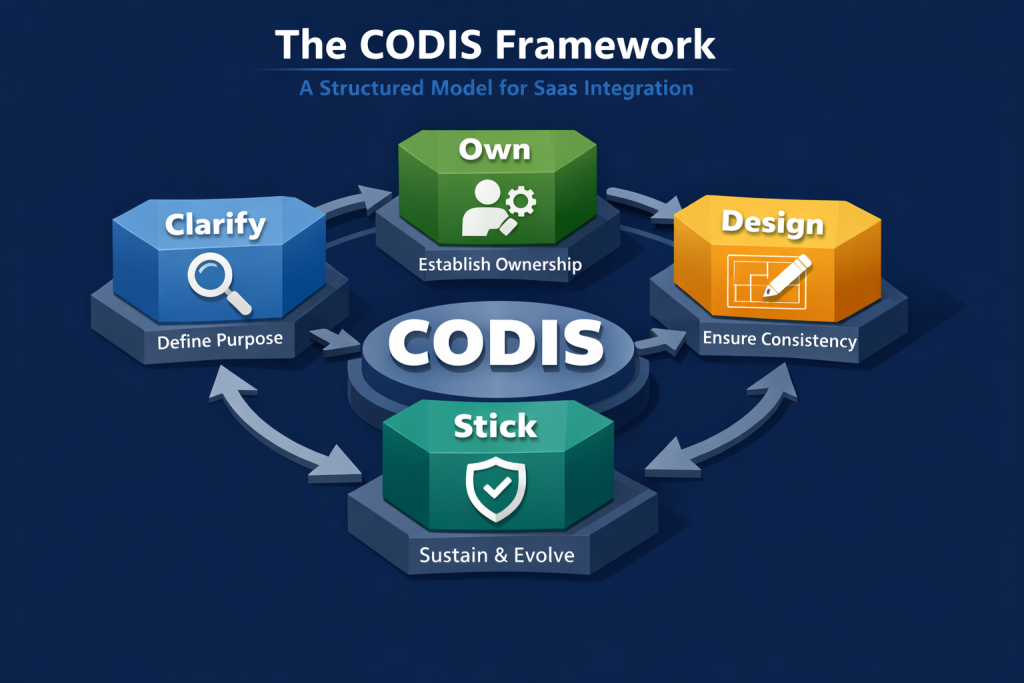
This led me to organize the five core principles into a structured and repeatable framework — one that connects clarity, ownership, design, integration patterns, and sustainability into a cohesive operating model.
CODIS: Connecting Principles into a Cohesive Model
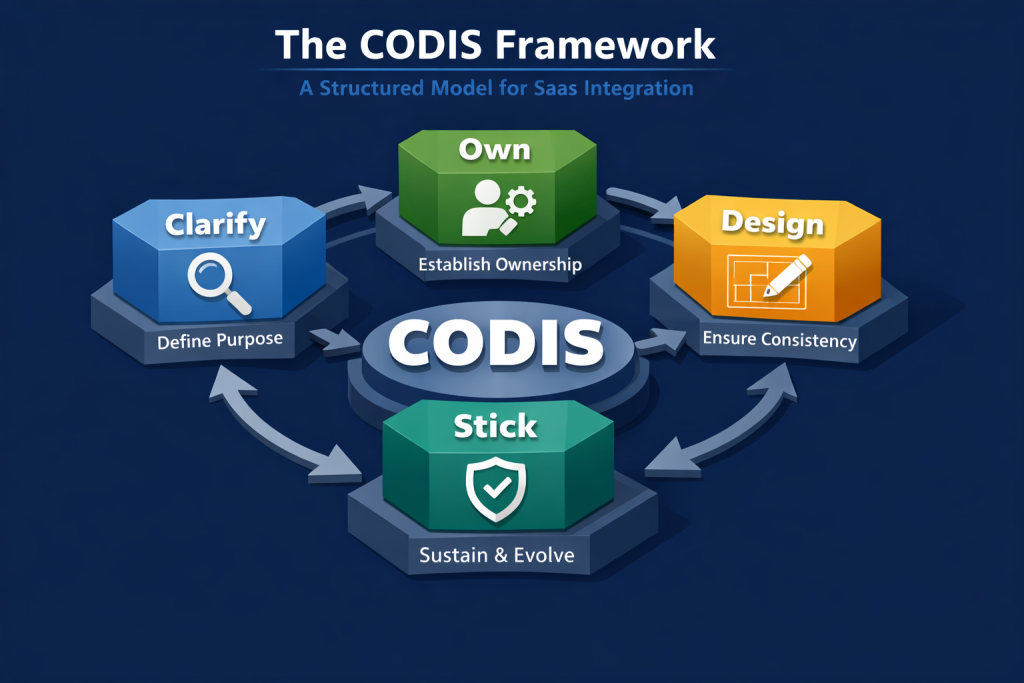
I refer to this structured approach as CODIS — a practical framework for building and sustaining SaaS integration operating models.
CODIS is built around five interconnected dimensions:
- Clarify — Define the purpose and business value of each integration.
- Own — Establish clear accountability for both technical performance and functional alignment.
- Design — Apply consistent design principles to reduce variability and risk.
- Integrate — Use intentional integration patterns that support scalability and resilience.
- Stick — Ensure integrations evolve safely through lifecycle discipline.
Each element addresses a critical aspect of integration maturity.
Together, they form a system.
Why CODIS Works as a System
CODIS is not a checklist.
It is not a sequence of steps to follow once.
It is a structured way of thinking that connects decisions across the lifecycle of an integration.
Its strength lies in interdependence:
- Clarity without ownership creates intent without accountability.
- Ownership without design creates control without consistency.
- Design without integration patterns creates structure without scalability.
- Integration without sustainability creates systems that eventually fail.
CODIS ensures that these dimensions are not treated in isolation.
It provides a way to align decisions so that integration environments remain coherent over time.
From Reactive Integration to Structured Discipline
In many organizations, integration evolves reactively.
A need arises.
A solution is built.
Another need appears.
Another integration follows.
Over time, this creates complexity that is difficult to manage and even harder to scale.
A structured framework changes that dynamic.
Instead of reacting to each integration independently, decisions are guided by a consistent model:
- Why does this integration exist?
- Who owns it?
- How should it be designed?
- What pattern should it follow?
- How will it evolve?
This shift moves organizations from improvisation to discipline.
Why This Matters Now
The pace of SaaS adoption continues to accelerate.
Organizations are no longer managing a handful of systems.
They are managing ecosystems.
As that ecosystem grows, the cost of unstructured integration increases exponentially:
- more dependencies
- more points of failure
- more effort to maintain consistency
Without a structured approach, integration becomes a limiting factor.
With structure, it becomes an enabler.
Closing — Structure as a Strategic Advantage
SaaS integrations don’t fail because organizations lack tools.
They fail because decisions are disconnected.
Sustainable integration requires more than isolated best practices.
It requires a framework that connects purpose, ownership, design, patterns, and lifecycle into a coherent whole.
CODIS is one way to bring that structure into practice.
In the next article, I’ll explore how this framework can be applied in real-world integration environments — and what changes when organizations move from theory to execution.
Because integrations that last are not built by chance.
They are built with structure and discipline.