
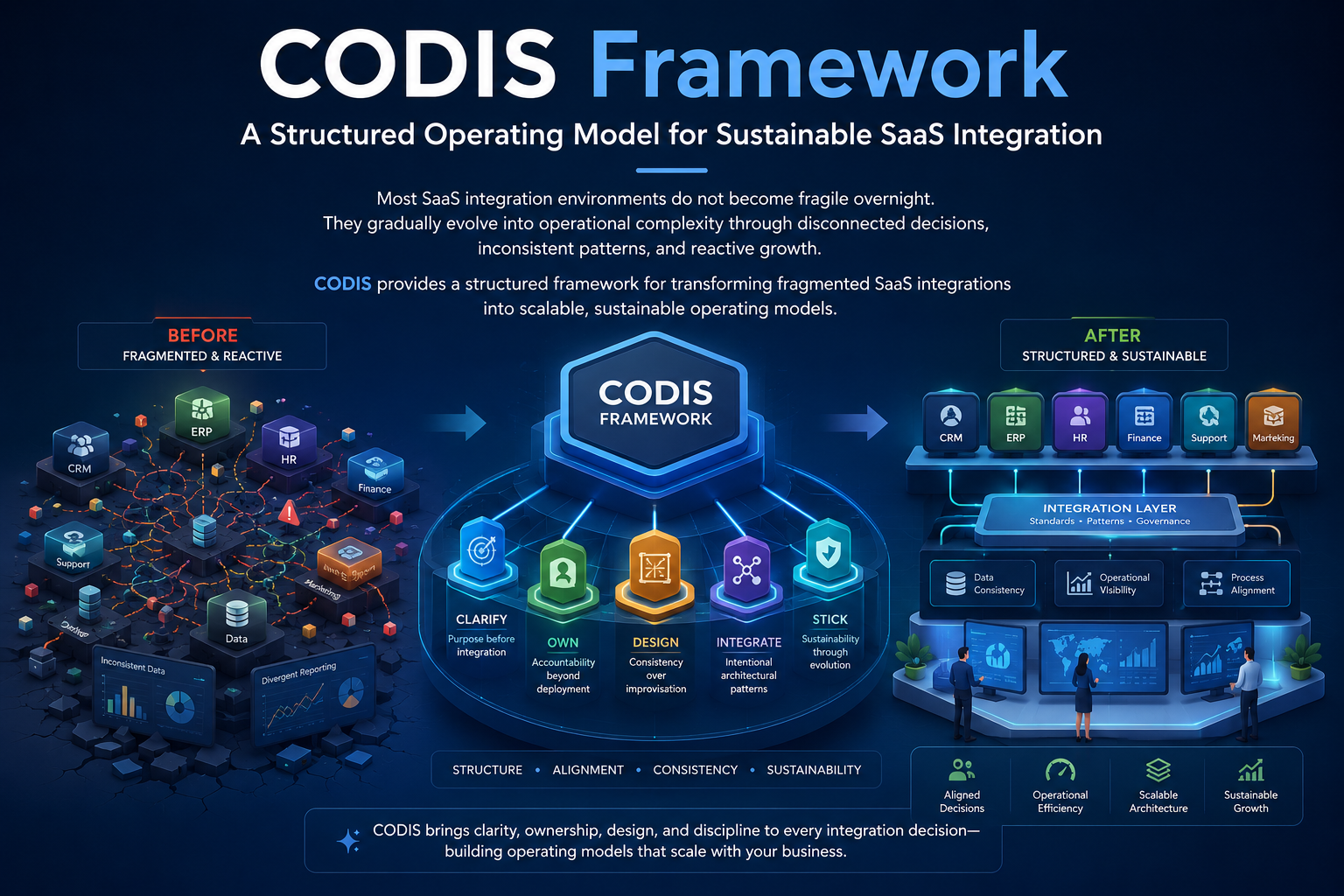
A Structured Operating Model for Sustainable SaaS Integration
Most SaaS integration environments do not become fragile overnight.
They gradually evolve into operational complexity through disconnected decisions, inconsistent patterns, and reactive growth.
CODIS provides a structured framework for transforming fragmented SaaS integrations into scalable, sustainable operating models.
The Real Problem
Modern organizations rarely struggle because they lack technology.
In most cases, they already have:
- SaaS platforms
- integrations
- reporting tools
- automation workflows
- cloud applications
Yet operational complexity continues to grow.
As organizations expand across regions, departments, and business units, integration environments often evolve independently.
Different teams adopt different systems.
Regional processes diverge.
Data structures become inconsistent.
Reporting logic varies across platforms.
Over time, integrations that were originally created to improve efficiency begin creating operational friction instead.
Organizations start experiencing:
- fragmented visibility across systems
- duplicate or inconsistent data
- growing dependency chains
- reactive operational support
- increasing difficulty scaling integrations safely
The challenge is rarely the lack of tools.
The challenge is the lack of structure connecting those tools together.
Without a consistent operating model, SaaS integration environments gradually evolve into disconnected ecosystems driven by local decisions rather than organizational alignment.
This is where operational fragility begins.
Why Traditional Integration Approaches Fail
Many SaaS integration initiatives begin with the right intentions.
Organizations invest in:
- new platforms
- automation tools
- integration middleware
- cloud ecosystems
- reporting environments
Yet despite these investments, operational fragmentation often continues to increase.
Why?
Because many integration strategies focus primarily on technology implementation rather than operational structure.
Integrations are frequently approached as:
- isolated technical projects
- short-term automation initiatives
- reactive business requests
- platform-to-platform connections
But sustainable integration environments require more than connectivity.
They require operational alignment.
In many organizations:
- ownership remains unclear
- architectural patterns evolve inconsistently
- integration decisions are made independently across teams
- operational dependencies accumulate silently over time
As SaaS ecosystems continue expanding, this reactive model becomes increasingly difficult to sustain.
The result is often:
- integration sprawl
- inconsistent governance
- fragile operational dependencies
- increasing maintenance complexity
- reduced organizational visibility
Technology alone does not solve these problems.
Additional tools often increase complexity when no consistent operating structure exists to guide integration decisions.
This is why many organizations eventually discover that successful SaaS integration is not only a technical challenge.
It is an operational discipline.
Introducing CODIS
CODIS was developed as a structured framework for addressing the operational complexity that emerges as SaaS integration environments evolve over time.
Rather than focusing only on connectivity between systems, CODIS approaches integration as an operational discipline that requires alignment across:
- business objectives
- ownership
- architectural decisions
- integration patterns
- long-term sustainability
The framework was designed around a simple but critical observation:
Most integration environments do not fail because organizations lack technology.
They fail because integration decisions evolve without a consistent operational structure guiding them.
CODIS introduces that structure.
The framework is organized around five interconnected dimensions:
C — Clarify
Define the operational purpose behind every integration decision before implementation begins.
O — Own
Establish clear accountability for integration lifecycle ownership beyond initial delivery.
D — Design
Promote consistency, scalability, and operational resilience through intentional design principles.
I — Integrate
Select architectural patterns deliberately based on operational requirements, scalability, and dependency management.
S — Stick
Ensure integrations remain sustainable as business environments, platforms, and operational needs evolve over time.
Together, these five dimensions create a structured operating model for building SaaS integration environments that are not only functional, but scalable, maintainable, and operationally aligned.
CODIS does not attempt to eliminate complexity.
It provides a disciplined structure for managing it intentionally.
The Five Dimensions of CODIS
CODIS organizes SaaS integration environments through five interconnected dimensions designed to bring structure, clarity, and operational sustainability to complex ecosystems.
Each dimension addresses a critical aspect of integration maturity.
Together, they create a cohesive operating model for managing integration complexity intentionally rather than reactively.
Clarify
Every integration should begin with a clearly defined operational purpose.
CODIS emphasizes understanding:
- why systems should be connected
- what business outcome is expected
- how the integration supports operational alignment
Without clarity, integrations often evolve into disconnected automations that increase complexity without delivering sustainable value.
Own
Sustainable integrations require accountability that extends beyond deployment.
CODIS treats ownership as a continuous operational responsibility involving:
- lifecycle management
- operational monitoring
- business alignment
- long-term maintainability
Delivery alone does not create sustainability.
Ownership does.
Design
As SaaS ecosystems grow, inconsistency becomes a major source of operational fragility.
CODIS promotes intentional design principles that improve:
- consistency
- scalability
- maintainability
- resilience
Structured design reduces variability and creates more predictable integration environments over time.
Integrate
Integration patterns should be selected deliberately based on operational requirements rather than convenience alone.
CODIS encourages organizations to evaluate:
- dependency management
- scalability needs
- synchronization requirements
- architectural coupling
Integration architecture should evolve intentionally — not accidentally.
Stick
SaaS environments continuously evolve.
Platforms change.
APIs evolve.
Business priorities shift.
CODIS emphasizes sustainability by ensuring integrations can adapt safely over time without creating uncontrolled operational complexity.
The goal is not simply to deploy integrations.
The goal is to ensure they remain operationally sustainable as organizations grow and evolve.
What Changes When CODIS Is Applied
Applying CODIS does not immediately simplify complex SaaS environments.
What changes first is not the technology.
It is the structure guiding integration decisions.
Organizations begin shifting from reactive implementation toward intentional operational alignment.
Instead of treating integrations as isolated technical activities, integration decisions become connected through a shared operational model.
Over time, several changes begin to emerge.
From Fragmentation to Visibility
Disconnected integrations often create environments where operational dependencies are poorly understood.
As CODIS introduces structure and consistency, organizations gain greater visibility into:
- integration relationships
- ownership boundaries
- operational dependencies
- architectural patterns
This visibility reduces uncertainty and improves decision-making across teams and regions.
From Reactive Support to Operational Discipline
Many organizations spend significant time responding to integration issues after they occur.
CODIS encourages a more disciplined operational approach where:
- ownership is clearly defined
- patterns are intentionally selected
- sustainability is considered early
- architectural decisions become more predictable
The result is not the elimination of operational challenges.
The result is improved organizational control over complexity.
From Independent Decisions to Organizational Alignment
In fragmented SaaS environments, teams often make integration decisions independently based on local priorities.
Over time, this creates:
- inconsistent data structures
- divergent operational processes
- conflicting integration patterns
CODIS introduces a shared structure that helps organizations align integration decisions across business units, operational teams, and evolving platforms.
This alignment becomes increasingly important as organizations scale.
From Short-Term Delivery to Long-Term Sustainability
Many integration initiatives focus primarily on implementation speed.
CODIS expands the focus toward long-term operational sustainability.
Integrations are evaluated not only by whether they function today, but also by:
- how safely they can evolve
- how dependencies are managed
- how resilient they remain as systems change
- how maintainable they become over time
The objective is not simply successful deployment.
The objective is sustainable operational evolution.
CODIS does not replace technical expertise.
It provides a structured operational framework that helps organizations apply that expertise more intentionally across complex SaaS ecosystems.
Related Insights & Articles
CODIS continues evolving through practical exploration of SaaS integration complexity, operational alignment, and architectural sustainability.
The following articles expand on many of the concepts introduced throughout this framework.
Why SaaS Integrations Need an Operating Model — Not More Tools
Explores why many organizations struggle with SaaS integration despite investing heavily in platforms and automation technologies.
👉 LINK
The 5 Core Principles of an Effective SaaS Integration Operating Model
Introduces the foundational principles that support sustainable integration environments across growing SaaS ecosystems.
👉 LINK
From Principles to Structure: A Practical Framework for Building a SaaS Integration Operating Model
Presents the formal introduction of CODIS as a structured framework for operational SaaS integration maturity.
👉 LINK
Applying CODIS: Moving from Ad-Hoc Integrations to a Structured Operating Model
Demonstrates how organizations can begin transitioning from fragmented integration environments toward more structured operational alignment.
👉 LINK
Coming Next
The Hidden Cost of Inherited Integration Architectures
A deeper exploration into how architectural dependencies, operational coupling, and reactive integration growth silently shape organizational complexity over time.
Looking Ahead
As SaaS ecosystems continue expanding, integration complexity will become increasingly operational rather than purely technical.
Organizations will continue adopting:
- new platforms
- automation technologies
- cloud services
- distributed operational models
But sustainable integration environments will depend less on the number of tools being implemented and more on the structure guiding how those tools evolve together over time.
CODIS was developed around that principle.
The framework is not intended to eliminate complexity.
Its purpose is to help organizations approach integration complexity more intentionally, consistently, and sustainably as operational environments continue evolving.
The ideas behind CODIS will continue expanding through future articles, architectural discussions, operational scenarios, and practical exploration of SaaS integration maturity.
Because long-term integration sustainability is not created through isolated technical decisions alone.
It is created through operational structure, alignment, and disciplined evolution.