
What changes when SaaS integrations are guided by structure instead of improvisation.
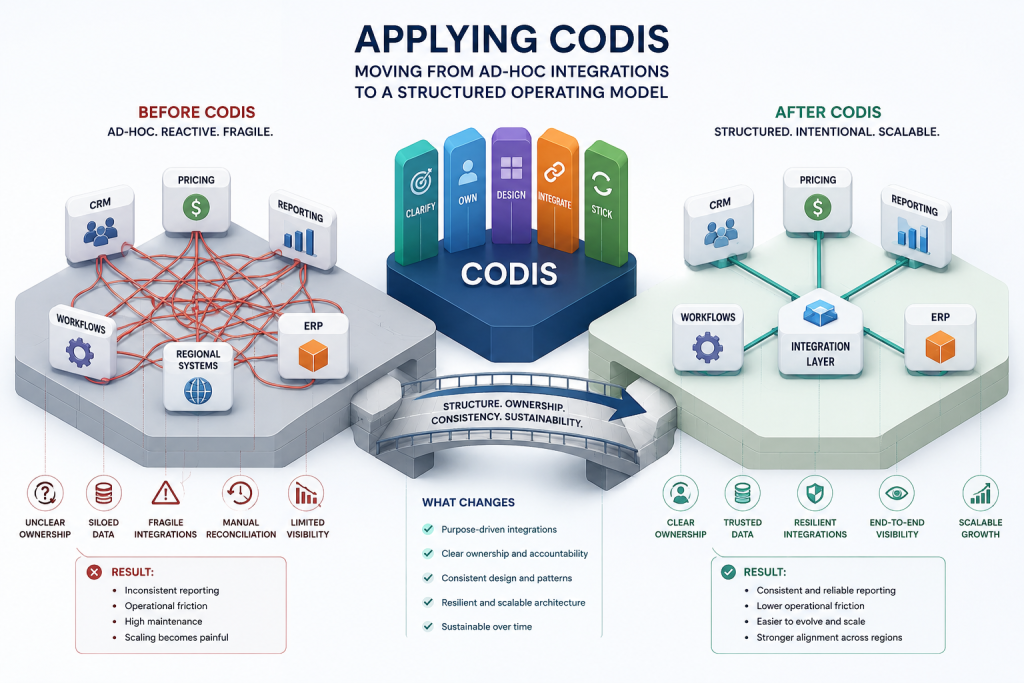
Most Organizations Don’t Realize They Are Operating Reactively
Most organizations do not intentionally design fragile integration environments.
They gradually drift into them.
A new SaaS platform is adopted.
A regional team implements its own workflow.
Another business unit creates a local reporting structure.
A custom integration is added to solve an urgent operational need.
Individually, each decision appears reasonable.
Collectively, however, complexity accumulates.
Over time:
- systems become increasingly disconnected
- ownership becomes unclear
- reporting loses consistency
- operational dependencies become difficult to understand
The organization continues functioning — but with growing friction beneath the surface.
This is how many ad-hoc integration environments emerge.
Not through a single mistake.
But through years of disconnected decisions.
The Problem with Ad-Hoc Integration Growth
One of the biggest misconceptions in SaaS integration is the assumption that complexity appears suddenly.
It rarely does.
Complexity accumulates incrementally:
- one integration at a time
- one workaround at a time
- one regional variation at a time
As organizations expand across regions, business units, and operational models, integration environments often evolve independently.
Different teams adopt different tools.
Data structures diverge.
Processes become locally optimized rather than globally aligned.
Eventually, organizations discover they cannot:
- consolidate reporting consistently
- establish unified operational visibility
- scale integrations safely
- evolve systems without disruption
Complexity rarely arrives as a single decision.
It accumulates through disconnected ones.
What Changes When CODIS Is Applied
CODIS does not eliminate complexity.
It organizes it.
The framework changes how integration decisions are approached before systems become difficult to manage.
Instead of treating integrations as isolated technical tasks, organizations begin evaluating them through a consistent operational structure.
Purpose becomes explicit.
Ownership becomes visible.
Design decisions become intentional.
Integration patterns become predictable.
Sustainability becomes part of the design itself.
The result is not rigidity.
The result is coherence.
Mini Scenario: From Reactive Integration to Structured Discipline
Consider a mid-size organization that has grown rapidly through SaaS adoption over several years.
Different regions implemented their own operational tools:
- CRM platforms
- pricing structures
- reporting environments
- workflow automations
Individually, most integrations worked.
Collectively, however, the environment became increasingly fragmented.
No one had a complete view of the integration landscape.
Regional processes evolved independently.
Reporting became inconsistent because data structures varied between systems.
As the organization continued to grow, operational friction increased:
- duplicate data appeared across platforms
- reporting required manual reconciliation
- integration dependencies became difficult to understand
- changes introduced unintended consequences
The organization did not suffer from lack of technology.
It suffered from lack of structure.
Applying CODIS did not eliminate complexity overnight. But it changed how integration decisions were made.
Each integration was re-evaluated through five dimensions:
- purpose
- ownership
- design consistency
- integration patterns
- sustainability
Over time, the environment became more predictable, scalable, and aligned.
The technology stack changed very little.
The decision structure changed significantly.
Applying “Clarify” — Purpose Before Connection
One of the most important shifts introduced by CODIS is the requirement to define purpose before integration.
Not every integration should exist simply because it is technically possible.
Every integration must support a clearly defined operational objective.
This changes the conversation from:
- “Can we connect these systems?”
to: - “Why should these systems be connected?”
Clarity reduces unnecessary integrations and helps organizations prioritize long-term operational value over short-term convenience.
Applying “Own” — Accountability Beyond Delivery
Many integrations lose ownership shortly after deployment.
Projects end.
Teams change.
Responsibility becomes diffuse.
CODIS treats ownership as a continuous operational responsibility rather than a temporary project task.
This includes:
- technical accountability
- operational monitoring
- business alignment
- lifecycle evolution
Delivery without ownership creates temporary success.
Sustainable integration requires accountability that persists over time.
Applying “Design” — Reducing Variability
As SaaS ecosystems grow, inconsistency becomes one of the largest hidden risks.
Different naming conventions.
Different error-handling approaches.
Different architectural assumptions.
Over time, this variability increases operational fragility.
CODIS promotes design consistency not to restrict innovation, but to reduce unpredictability.
When integrations follow consistent principles:
- troubleshooting becomes simpler
- onboarding becomes faster
- scaling becomes safer
Consistency creates operational resilience.
Applying “Integrate” — Choosing Patterns Intentionally
Many organizations inherit integration architectures that evolved reactively over time.
Point-to-point connections multiply.
Synchronous dependencies create bottlenecks.
Operational coupling increases silently.
CODIS encourages organizations to evaluate integration patterns intentionally:
- where synchronous interactions are appropriate
- where asynchronous approaches reduce operational risk
- where scalability requires decoupling
Architecture should not emerge accidentally.
It should evolve deliberately.
Applying “Stick” — Designing for Evolution
The true test of an integration is not deployment.
It is survivability.
SaaS environments constantly evolve:
- APIs change
- business priorities shift
- platforms are replaced
- organizational structures evolve
Without sustainability discipline, integrations degrade over time.
CODIS emphasizes:
- lifecycle awareness
- monitoring
- documentation
- controlled evolution
Integrations that cannot evolve safely eventually become operational liabilities.
CODIS as an Organizational Shift
CODIS is not simply a technical framework.
It is an operational shift in how organizations think about integration itself.
It changes integration from:
- reactive implementation
to: - structured operational discipline
The framework does not eliminate complexity.
But it prevents complexity from becoming unmanaged fragility.
As SaaS ecosystems continue to expand, this distinction becomes increasingly important.
Closing — Structure Before Scale
Organizations rarely struggle because they lack integrations.
They struggle because their integrations lack structure.
SaaS integration environments do not become sustainable through tools alone. They become sustainable through disciplined decision structures that connect purpose, ownership, design, patterns, and evolution into a coherent operating model.
CODIS is one practical way to bring that structure into place.
Because integrations that scale successfully are not built through improvisation.
They are built through structure, alignment, and discipline.